Why I even bother with launch directories
Here's the honest starting point: direct outreach is still the highest-converting thing I do. DMs, cold emails, replying in the right Reddit thread at the right moment, a well-timed X post. It works. It also doesn't scale past what I can personally type in a single day, and some days I just don't have it in me to write forty personalized messages. Launch directories promise the opposite: submit once, and in theory it keeps working quietly in the background while I'm off doing literally anything else. That's an incredibly appealing trade for a solo dev. The problem is that most of these directories don't actually deliver on it — you submit, you get one day of a small trickle of curious clicks, and then your listing sinks to page fourteen of a list nobody scrolls to, forever. It's a link dump wearing a launch-platform costume. So when I decided to actually write about NickLaunches instead of just quietly submitting and moving on, that was the bar it had to clear first: does this actually keep working after day one, or is it the same graveyard with a nicer homepage?
Quick detour: what do "backlink" and "DR" even mean?
If you've spent any time around indie hackers or SEO Twitter, you've probably seen people throw around words like these as if everyone's supposed to just know what they mean. Most people nod along and never actually ask. So here's the plain version — no jargon assumed.
Backlink
A link from somewhere else on the internet pointing to your site. Search engines treat backlinks a bit like word-of-mouth: a lot of sites linking to yours reads as a signal that your site is probably worth something, the same way a restaurant with a line out the door gets treated as more trustworthy than an empty one across the street.
DR (Domain Rating)
A score from 0 to 100 estimating how much authority a site has built up, mostly based on how many OTHER trustworthy sites link to it. A backlink from a brand-new blog with zero history is worth very little. One from an established, well-linked domain actually carries real weight with search engines.
Dofollow vs. nofollow
The confusing one, because it's invisible. Dofollow tells search engines "this vote of confidence counts." Nofollow is the same clickable link for a human, but carries a tag telling search engines "don't count this one." Sites use nofollow for paid placements so people can't just buy their way up the rankings.
What NickLaunches actually does differently
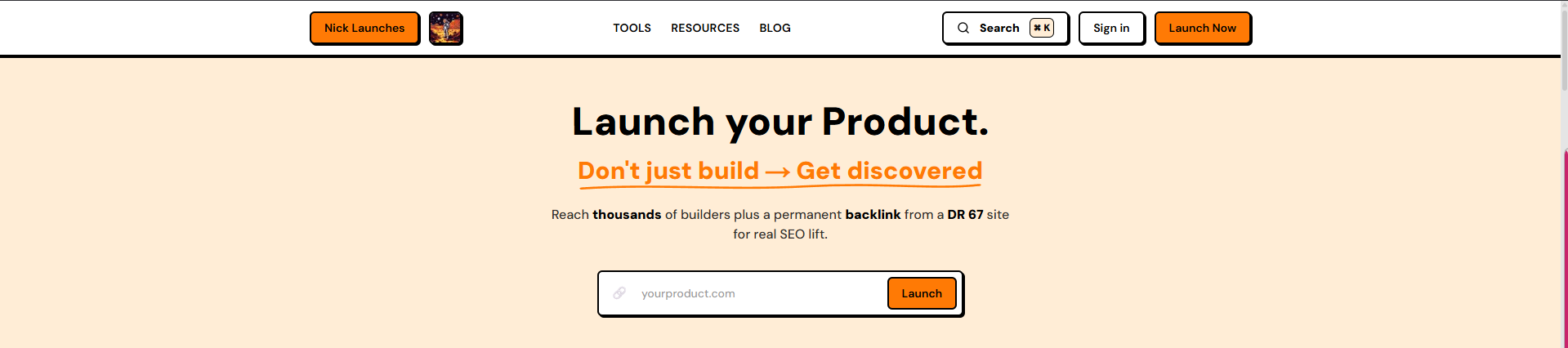
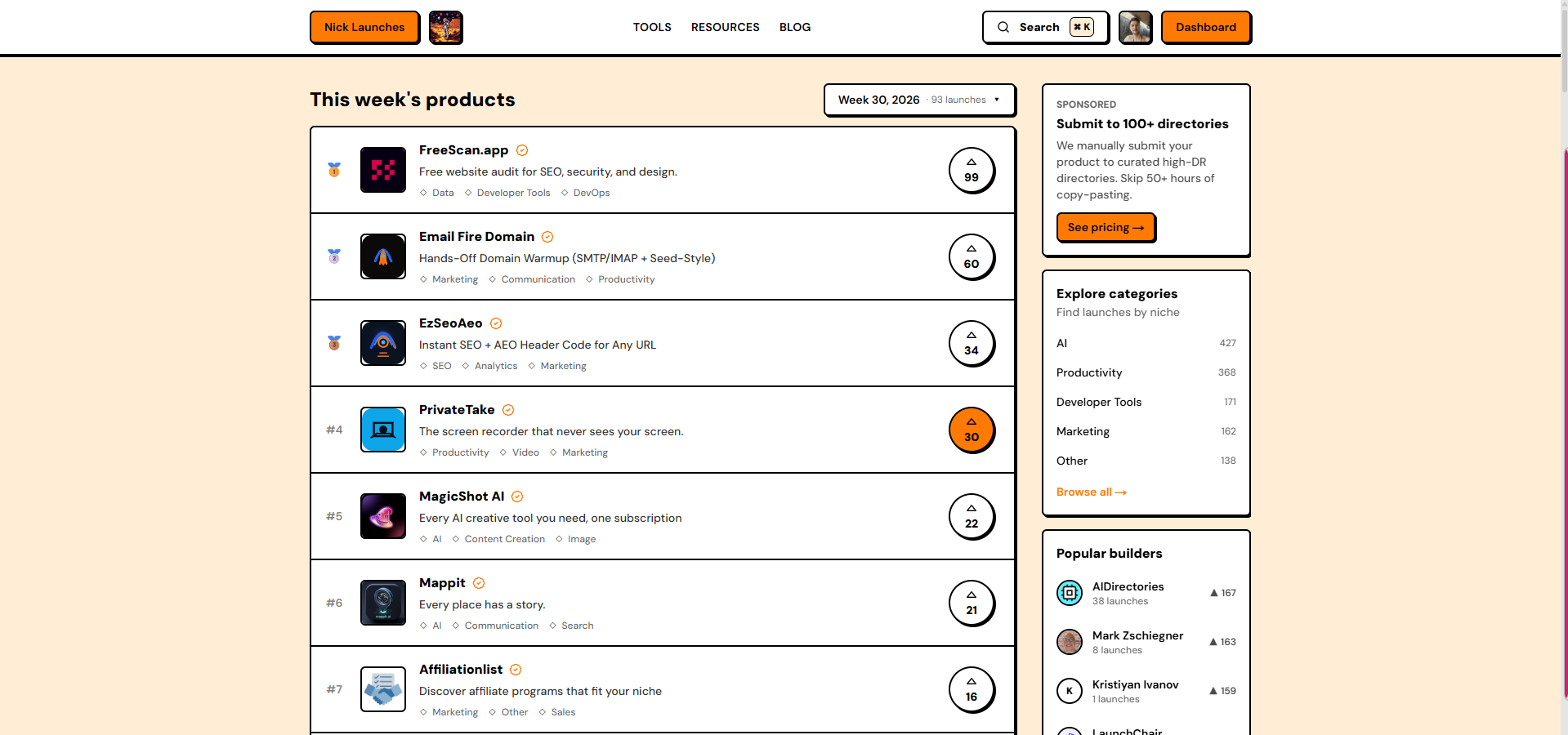
With that out of the way — two things stood out to me immediately, and both directly connect to what I just explained. First, listings don't die after 24 hours. Products rotate through "this week / last week / last month" placements, so a launch keeps getting seen by real visitors for weeks instead of one spike of traffic followed by total silence. Second — and this is the part that actually matters once you know what DR and dofollow mean — every approved product gets a permanent, indexed page with a genuine dofollow backlink from the domain, not a nofollow throwaway or a buried row in a giant table nobody scrolls to.
DR 67
domain rating
1,000+
visitors / day
200+
new products / week
$0
to launch
The part I almost missed: analytics and tools
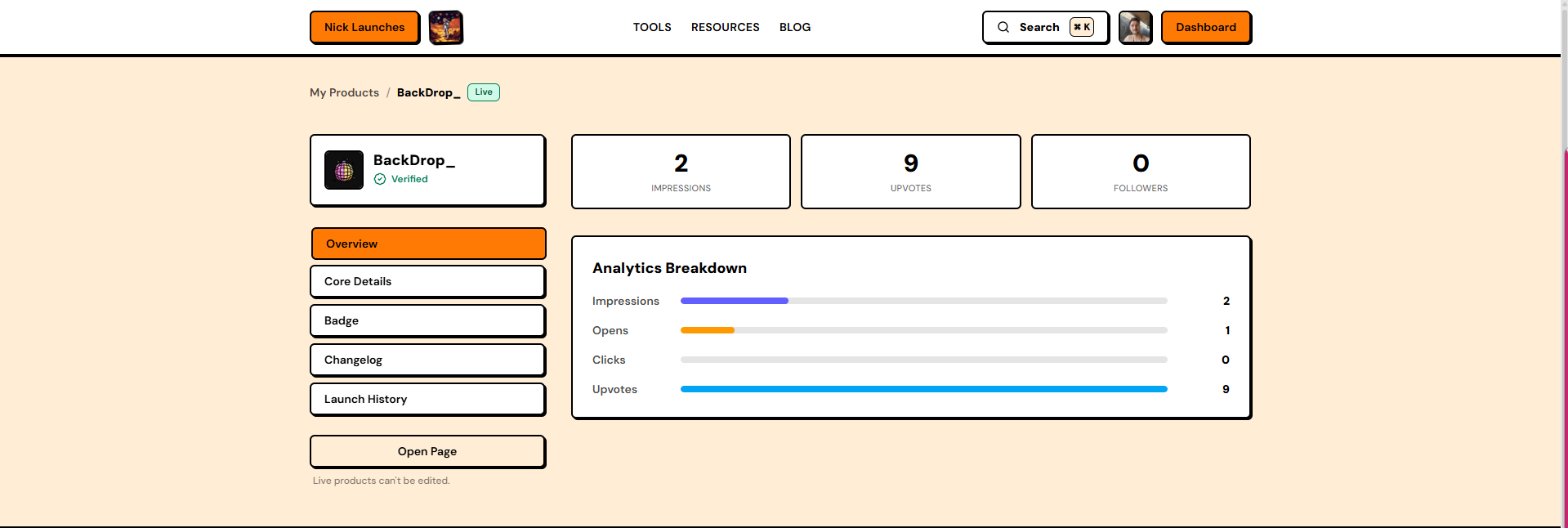
Here's something that would've been easy to miss if you don't dig past the listing page itself: every product gets its own analytics dashboard — impressions, opens, clicks, upvotes, tracked in one place instead of guessing whether anyone actually saw your listing. It's not a vanity-metric wall, it's an honest read on what a launch actually did, which is exactly the kind of thing I wish more "submit and pray" directories bothered to give you.
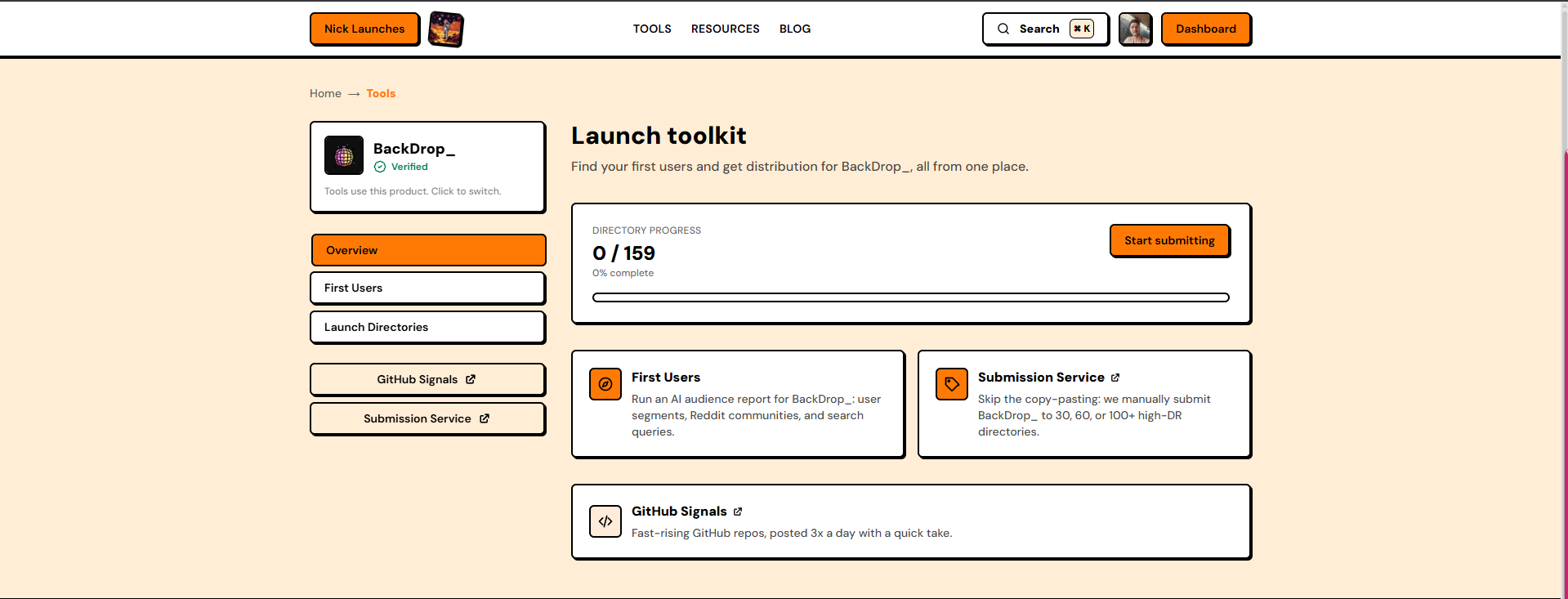
And the listing itself turns out to be the smaller part of what's on offer. Tucked behind the dashboard is a genuine toolset for the part that comes after the launch: a tracker for 158+ curated launch directories (DR, traffic tier, and backlink strength listed for each one, with a to-do / skipped / done workflow so you're not re-discovering the same directories from scratch every time), plus a "First Users" tool and a "GitHub Signals" tool sitting right next to it in the same sidebar. It's the difference between a platform that wants you to submit once and disappear, and one that's clearly trying to be a place builders keep coming back to.
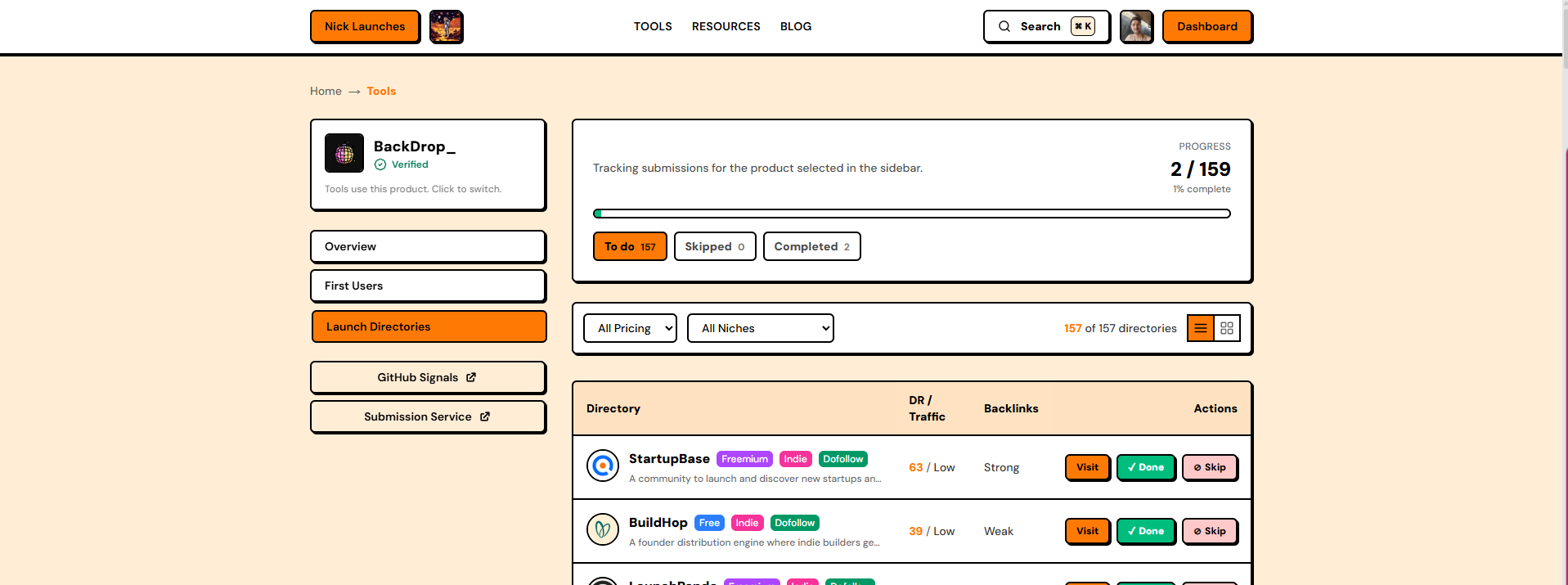
What it's actually like to use — not just what the homepage promises
Here's the part I actually want to spend real time on, because it's the part every launch-directory writeup skips: what does it feel like to actually use the thing? Because a directory can have perfect mechanics on paper and still feel like filling out a tax form. NickLaunches doesn't. It's one of those rare products that manages to feel genuinely likeable and a little playful — almost fun to use, in a way I wasn't expecting from something in the "submit your startup here" category — while still being clearly, carefully built by someone who sweats the details.
Warm and a bit cheeky on one hand. Sharp and sophisticated on the other. Most products pick one lane and stay in it. This one doesn't.
Submitting BackDrop_ didn't feel like filing paperwork into a void — it felt like using something a real person actually cared about, down to small touches most directories skip entirely. And the actual listing page reflects that same care: real description, a real link back to sublimearts.io, an embedded demo, a real "limited time" discount badge, no clutter competing for attention. A slow, cluttered, ugly directory page reflects badly on whatever product is sitting on it — the same way a business card printed on flimsy paper makes you second-guess the business itself. This one doesn't have that problem. It's early days for what this specific listing does for traffic long-term, but the page itself is genuinely the kind of thing I'd link to directly without flinching — which, after trying a small pile of these platforms, is not something I can say very often.
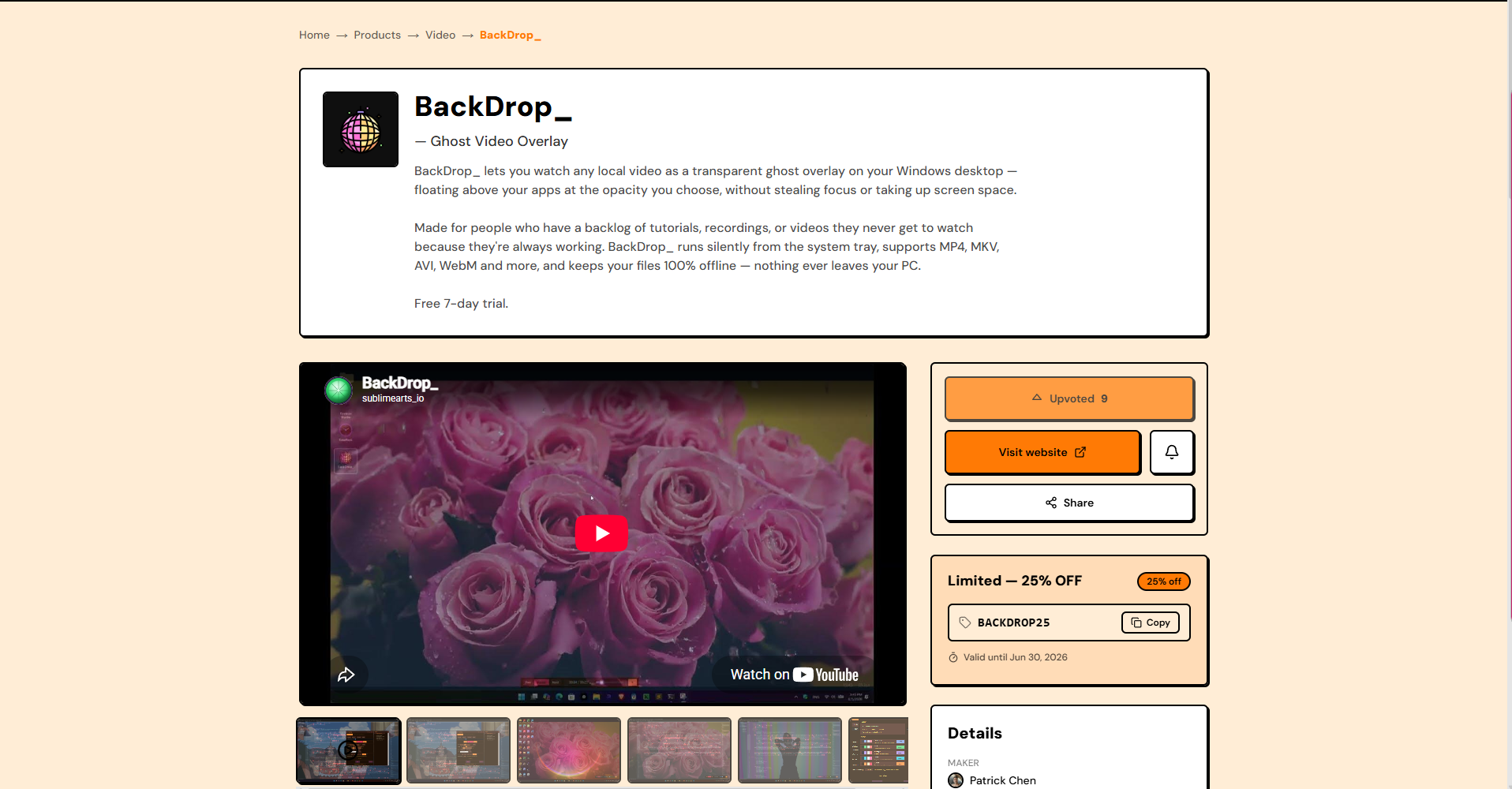
The part I'm genuinely considering next
Beyond the directory itself, Nick also runs a manual directory submission service — hand-submitting a product to a curated batch of 30, 60, or 100+ high-DR directories, done by an actual person instead of the usual automated blast-and-pray approach, with tiers starting at $99. I haven't used it yet, but I'm honestly weighing it for BackDrop_'s next release. The manual, curated angle is the exact same reason NickLaunches itself was worth writing about in the first place — so it reads to me as a believable extension of something that already earned some trust, not a generic upsell tacked onto the end of a sales page.
→ Directory submission service (nicklaunches.com)If any of this made you curious rather than convinced — good, that was the point. Go actually look at the page yourself, click around, see if the "simpatico but sharp" thing I'm describing lands the same way for you. That's genuinely a better test of whether any of this is true than taking my word for it.
Check out NickLaunches →About
Patrick Chen — indie developer behind Sublimearts.io. I write about the actual tools and channels I use to get my own software (BackDrop_, ReelNox Studio, Time Precision) in front of people, not generic "top 10 launch site" listicles.